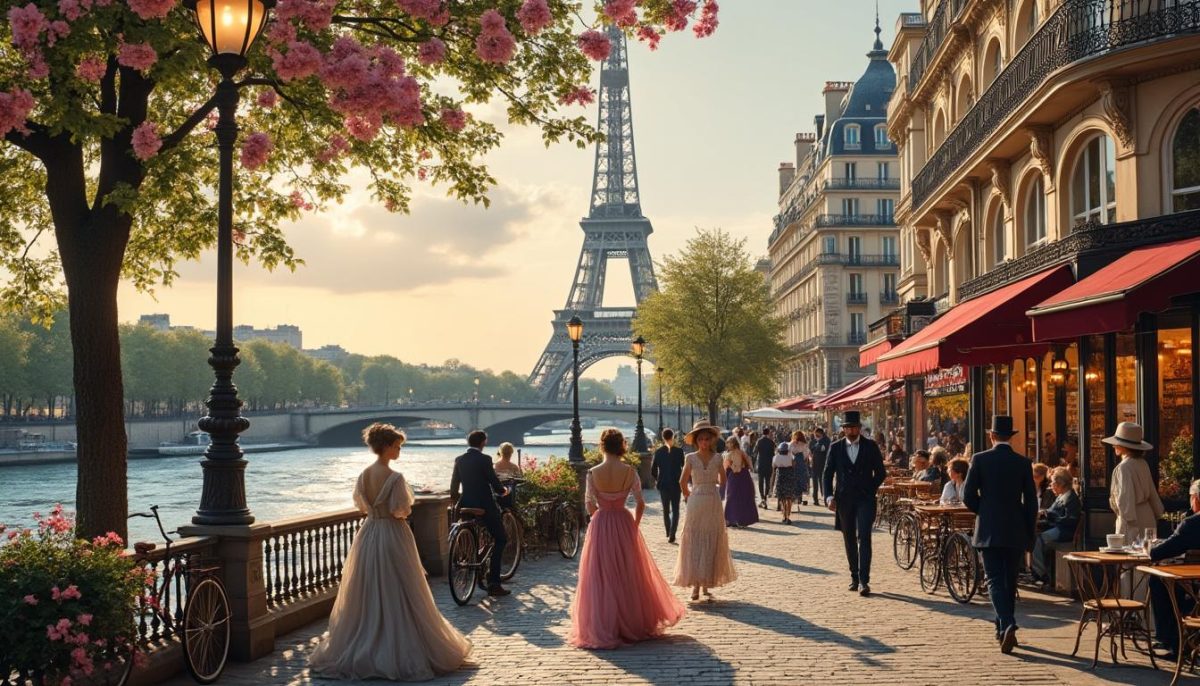
In the heart of Paris, the Eiffel Tower stands as a testament to human ingenuity, a mixed symbol of national pride, and a subject of intense debate. When the French government envisioned the structure to commemorate the centennial of the French Revolution, they sought an architecture that would encapsulate innovation in engineering while providing a landmark for the world to admire. As the plans unraveled, what began as a noble ambition met fierce opposition. Renowned artists and intellectuals, including literary figures like Alexandre Dumas fils and Guy de Maupassant, publicly criticized the design, arguing it sullied the elegance of the Parisian skyline. Despite the outcry, the Eiffel Tower emerged from its tumultuous beginnings to become a beloved icon, marrying art and engineering in a way never seen before.
The Concept and Creation of the Eiffel Tower
The journey of the Eiffel Tower began in earnest in 1886 when the organizing committee for the 1889 Universal Exposition issued a call for proposals. The aim was to erect a fitting monument on the Champ de Mars, symbolizing the spirit of innovation that defined the era. Gustave Eiffel, whose company had already made a name for itself with its elaborate iron bridges, seized the opportunity to propose a structure inspired by the principles of bridge engineering. His initial designs were ambitious—envisioning a tower that would soar to a staggering height of 300 meters, redefining the boundaries of architecture at that time.
Upon examining 19 varied proposals, including eccentric ideas such as a gargantuan guillotine replica and a massive granite lighthouse, the organizing committee awarded Eiffel’s submission first place. The design crafted by Eiffel’s chief engineer, Maurice Koechlin, was not merely an abstract triumph of iron and rivets; it represented the zenith of contemporary engineering capabilities. Their vision included accurate representations of iconic Parisian structures, carefully stacked to emphasize just how tall the Eiffel Tower would stand. This concept captures not just ambition but the revolutionary spirit of the age, setting the stage for a grand architectural spectacle.
The Engineering Marvel of the Tower
Constructing the Eiffel Tower was a feat of engineering that required unparalleled skills and innovative techniques. The building process, spanning over two years, was a meticulous undertaking involving the assembly of around 18,000 iron parts fastened together by approximately 2.5 million rivets. Each piece of iron was crafted in such a manner as to ensure structural integrity while maintaining the aesthetic that Eiffel envisioned. During its construction, the team had to work in a time when safety standards were far less stringent than today, making each decision even more critical when considering the tower’s future.
The assembly was akin to a grand puzzle that required not only engineering precision but also an understanding of the stresses that would affect the overall stability once completed. With a towering ambition, Eiffel’s design allowed for efficient wind resistance and minimal sway, elements that are of paramount importance for tall structures. On May 6, 1889, the completed tower opened to the public, showcasing not just its impressive height but the spirit of revolution that flowed through its iron beams.
Departure from Convention: A Controversy Unfolds
Even before the tower’s construction reached its zenith, the project was embroiled in controversy. A notable petition circulated in February 1887, signed by prominent artists and intellectuals, who labeled Eiffel’s creation as an “eyesore.” Their disdain resonated throughout Paris and beyond, igniting debates over the aesthetics of modern architecture versus historical preservation. As literary giants and cultural leaders decried the tower, they questioned whether such a structure could truly represent the heart of Paris, a city wealthy in history and tradition.
This controversy reached a fever pitch in 1889, just as the iron behemoth edged closer to its completion. Critics described the projected shadows as “odious,” arguing that the design overshadowed the classical beauty of existing Parisian landmarks. It wasn’t just a disagreement over style or aesthetics; this was a fundamental clash of ideas about what Paris should embody. Should it embrace modernity, or was it to remain a bastion of historical architecture?
The Power of Time: From Ridicule to Reverence
As the debates surrounding the Eiffel Tower simmered, the structure began to redefine not only the skyline of Paris but also the perceptions of avant-garde architecture. What had once been an emblem of derision transformed into a cherished symbol of love and romance. Millions flocked to admire its intricate design, captivating aesthetics, and breathtaking views. By the time the Exposition Universelle concluded in October 1889, over two million visitors had ascended its heights, reclaiming the narrative surrounding the monument.
The Eiffel Tower, with its soaring presence, soon became synonymous with Paris. It offered panoramic views that showcased the beauty of the city below, enchanting visitors from far and wide. The structure began to influence the architectural landscape, inspiring future engineering feats and inviting ongoing discussions about the balance between modern innovation and classical beauty in urban development.
The Legacy of Gustave Eiffel: Beyond the Tower
Gustave Eiffel’s legacy extends far beyond the iron lattice that defines a significant part of Paris’s identity. Born in Dijon in 1832, Eiffel’s engineering career was marked by various achievements, including the design of the internal structure of the Statue of Liberty. Nonetheless, the Eiffel Tower would become his most recognized work, a representation of both triumph and controversy. Even while constructing the tower, Eiffel was involved in the ambitious Panama Canal project, which suffered a catastrophic failure that briefly tarnished his professional reputation.
Despite such setbacks, Eiffel remained committed to the advancements in science and engineering. He famously utilized the Eiffel Tower as a laboratory for aerodynamics experiments, pushing the boundaries of knowledge and technology. The tower became an experiment ground, showcasing the intersection of architecture, science, and artistry—a place where the future was tested against the rigors of reality.
The Tower Today: An Enduring Symbol of Innovation
The Eiffel Tower is not merely a historic monument; it is a living symbol of innovation and a focal point for millions. Its architectural brilliance and storied past fuel fascination and admiration, inviting a diverse group of individuals to partake in its narrative. In the present day, visitors still flock to this iconic landmark, particularly drawn to its top level, where breathtaking views of the city serve as a reminder of both history and the continuous advancement of engineering principles.
As we move forward, the Eiffel Tower continues to inspire architects, engineers, and dreamers alike. It serves as a powerful reminder of how the union between art and engineering can reshape societal landscapes and influence generational thought, encouraging future innovations that honor both the past and the potential for what lies ahead.
| Year | Event | Significance |
|---|---|---|
| 1885 | French Government announces plans for a monumental tower | Start of the Eiffel Tower concept and proposal phase |
| 1886 | Call for proposals for a monument | A multitude of proposals including the Eiffel design |
| 1889 | Completion of the Eiffel Tower | Opened to the public, becoming an iconic symbol |