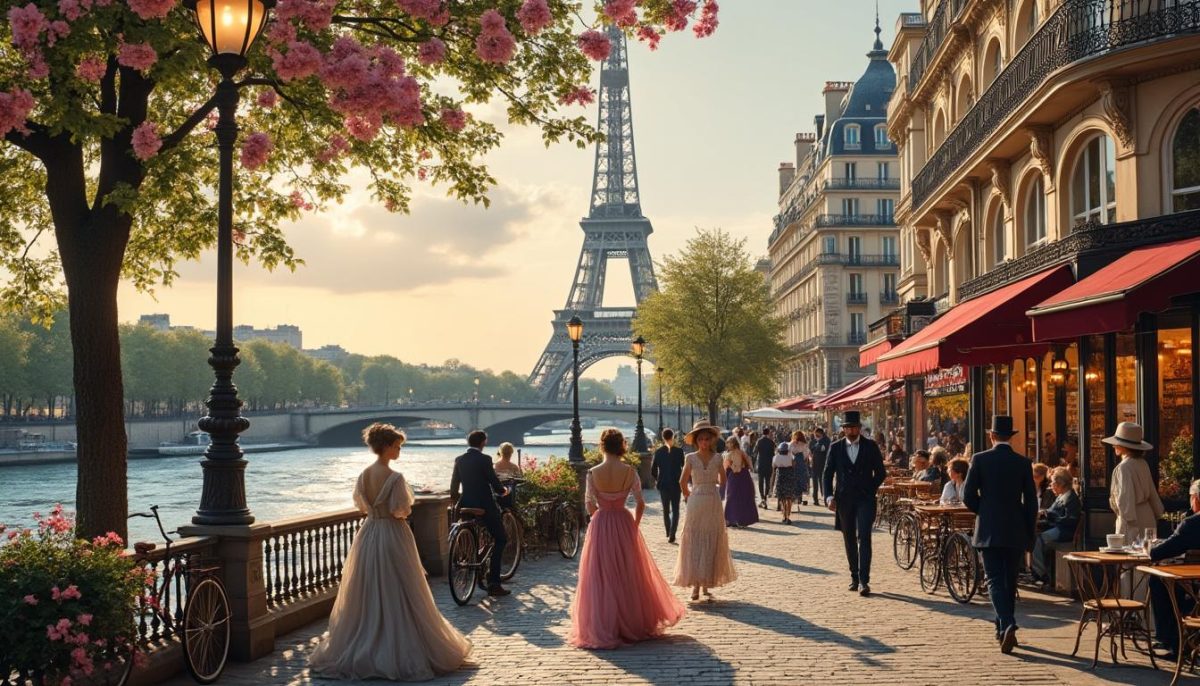
The rich history of Paris is a narrative woven from ancient threads, where Celtic roots intertwine with the echoes of Viking invasions. This captivating journey begins over 2,500 years ago, at a time when the Seine River flowed through verdant landscapes, fostering settlements that would evolve into one of the world’s most influential cities. The Parisii, a tribe of Celtic origin, found this fertile region ideal for establishing a community around 300 BCE. With its waterways brimming with fish and its strategic location, the area soon became a thriving hub of activity and cultural exchange, laying the groundwork for what would unfold in the centuries to come.
As one walks through the streets of Paris today, traces of this ancient heritage can be seen at every corner—from the remaining Roman ruins scattered throughout the city to the picturesque islands on the Seine that once served as defensive strongholds. Each stone tells a story, a testament to resilience amid the ebb and flow of historical tides. The early settlement of Paris would not remain unchallenged, facing invasions and transformations that redefined its landscape and identity numerous times throughout its existence. In exploring the layered history of the city, one gains a deeper appreciation for the cultural richness and historical complexity of Paris.
The Celtic Foundations of Paris
The origins of Paris start with the Celtic tribe known as the Parisii. This settlement established along the Seine around 300 BCE was not just a random choice, but a deliberate decision based on the land’s abundant resources and its strategic position for trade and defense. At this time, the Paris region was marked by seven islands, which offered natural fortification against potential intruders. The fertile banks of the Seine provided ample sustenance, allowing for agriculture and fishing to flourish, supporting a community that thrived economically.
The Parisii were not just fishermen; they were skilled merchants who traded goods across the region, leveraging their position along important trade routes. Evidence suggests that the tribe’s leadership may have consisted of wealthy merchant aristocrats, underscoring the social and economic stratification that existed even in these early days. This aristocratic class played a crucial role in shaping the politics and culture of the settlement.
By the first century BCE, the Parisii had established a robust community that would soon capture the interest of external powers. Their occupancy laid the essential groundwork for the future urban sprawl of Paris, as they developed rudimentary structures and societal norms that would evolve over time. An intriguing aspect of this period is the name itself—Paris likely derives from a Celtic term meaning “place to live in the waters,” reflecting the deep connection the inhabitants had with their environment.
The Influence of the Romans on Lutetia
As the centuries rolled on, the Romans recognized the strategic value of the Parisii settlement, leading to its annexation. By the 1st century BCE, under the auspices of Julius Caesar, the city was rebranded as Lutetia, heralding a new chapter in its history. The Roman period brought significant urban development, with roads, baths, and fortified walls that marked the landscape. Roman architecture and urban planning laid foundational elements for contemporary Paris, shaping its streets and public spaces.
The Romans were adept builders, creating not just infrastructure but also a cultural framework that influenced the local populace. By establishing civic baths and forums, they introduced elements of Roman civilization that would meld with the indigenous cultures. The remnants of the Roman baths at Musée de Cluny stand as a testament to this period, alluring visitors with glimpses of the past, while other archaeological findings reveal the extensive network of Roman roads and constructions scattered throughout the city.
The Turbulent Era of Invasions and Transformations
As the Roman influence waned, Paris entered a turbulent phase marked by various invasions, particularly during the 5th century CE. The Huns, led by the notorious Attila, invaded parts of France but spared the city. Shortly thereafter, the Franks, a Germanic tribe, began to assert their dominance, sealing the fate of Paris as an emerging center of power. Under King Clovis I, Paris was declared the capital of Frankish France, heralding a significant shift in the city’s political landscape. This transformation marked the beginning of Paris’s ascendancy as a notable political capital.
However, the struggle for supremacy was far from over. In response to the continuous threat from external forces, Clovis’s descendants fortified the city further and expanded its walls. It was during this juncture that the Left Bank began to develop more substantially. An abbey was founded by Clovis’s son, Childbert, in what is now the vibrant district of Saint-Germain-des-Prés. This establishment signified the shift of focus toward cultural and religious endeavors, giving rise to a rich historical tapestry interwoven with ecclesiastical heritage.
The Viking Invasions: A New Challenge
As the power dynamics shifted yet again, the 8th century saw the arrival of the Vikings, plunging Paris into chaos once more. These raiders from Scandinavia posed a formidable threat, leading to intense conflict and further fortification of the city. The leadership of Odo, Count of Paris, became critical in repelling the Viking invasions. His eventual ascension to the throne marked yet another turning point in Parisian history. It was under Charles the Simple’s reign that the Vikings were acknowledged as part of the realm in exchange for land that would be known as Normandy.
The Viking period saw a unique confluence of cultures and traditions, as these Norsemen interacted with the local populace, leaving an indelible mark on the region’s social and cultural fabric. Even after the threats subsided, the legacy of these invasions remained evident in the evolution of Paris’s defenses and urban planning, setting the stage for the city to emerge as a powerhouse in the medieval era.
Architectural Remnants of a Multilayered Past
In contemporary Paris, the layers of its history can be vividly discerned through its architecture—the majestic structures embodying the echoes of its Roman, medieval, and Viking past. A stroll through the city reveals ancient ruins juxtaposed with modern-day establishments, creating a dynamic landscape that is reflective of centuries of development. The remnants of the old Roman walls can still be encountered, artfully integrated into contemporary buildings, or standing proudly as monumental reminders of a time long gone. Similarly, fragments of medieval walls can be seen throughout the historical districts, showcasing the evolution of the city’s defenses against invaders.
Additionally, the famous art museum, the Louvre, illustrates this historical layering perfectly. Originally a fortress constructed in the late 12th century, it transformed into a royal palace before becoming the world’s most renowned museum. Such transitions highlight the ever-evolving identity of Paris, continuously adapting to the changing tides of history while retaining essential aspects of its heritage.
| Era | Key Developments | Significance |
|---|---|---|
| Celtic Settlement | Establishment of the Parisii tribe and trade routes | Foundation of Paris’s economic and social structure |
| Roman Rule | Construction of roads, baths, and walls | Introduction of Roman culture and public amenities |
| Frankish Empire | Paris becomes the capital of the Frankish kingdom | Beginning of Paris’s political prominence |
| Viking Invasions | Defense efforts and establishment of Normandy | Integration of diverse cultural influences |
The architecture and remnants left behind speak volumes about the city’s past and its resilience in the face of adversity. Paris serves not only as a living museum that houses artifacts from various epochs but also as a testament to the adaptability and spirit of its people. The vibrancy of Paris comes from this rich tapestry of history and culture, inviting both residents and visitors to uncover the stories interwoven in every corner.