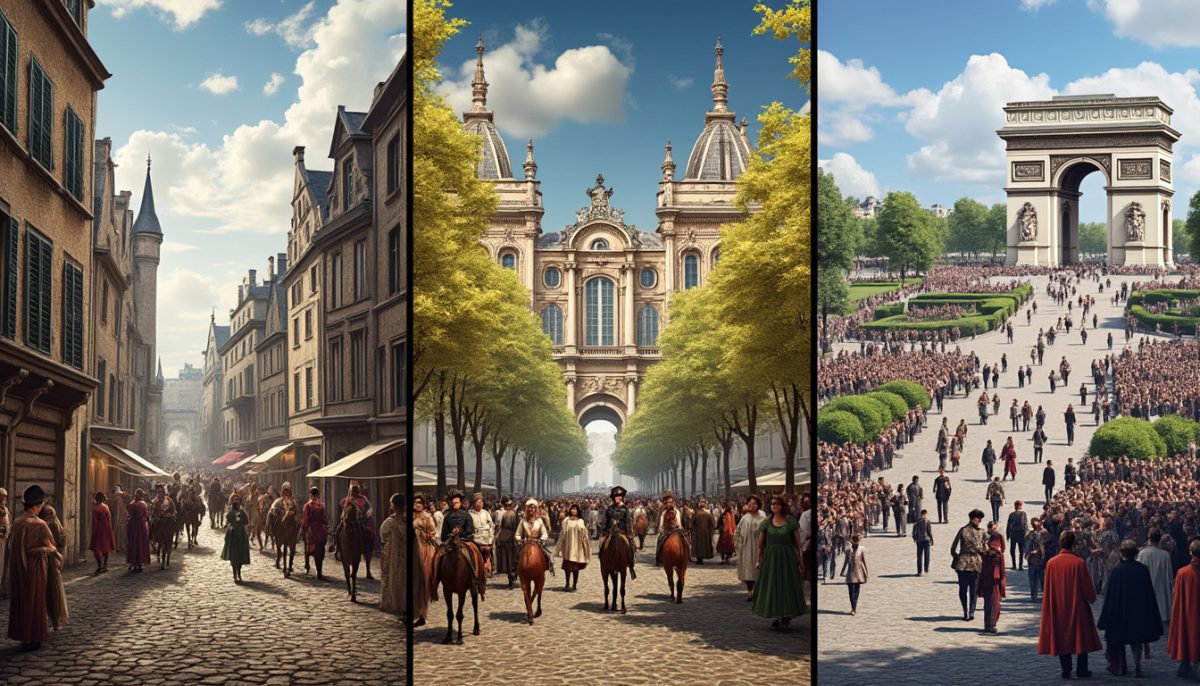
Paris is more than just a city; it is a living tapestry woven from centuries of history, culture, and architecture. The journey through its past reveals a vibrant story, beginning in the depths of the Middle Ages and culminating in the transformative era of Napoleon. As each chapter unfolds, we witness a blend of triumphs and challenges that have shaped the City of Light into the iconic metropolis it is today. The medieval foundations established a stronghold for commerce and learning, leading to a Renaissance that nurtured the arts and philosophy. The royal ambitions of successive monarchs introduced grand architectural projects, while the tumult of revolution heralded significant social change. This narrative takes us through an extraordinary timeline, where every street corner and monument tells a story of resilience and innovation.
The Middle Ages: Foundations of a Great City
During the Middle Ages, Paris emerged from its primitive roots as a settlement known as Lutetia. This period was marked by the establishment of the Frankish kingdom, with Paris functioning as a political and cultural hub. The reign of the Capetian dynasty began in the late 10th century, with kings such as Hugh Capet solidifying the city’s prominence on the European stage. Paris’s strategic location at the confluence of the Seine River made it an attractive target for various invaders, including the Huns and Vikings, who never succeeded in occupying the city. The most notable occupation came from the Franks, who established a lasting legacy.
The Middle Ages brought about significant developments in architecture and urban layout. Notably, in the 12th century, Paris became home to its first university, the Sorbonne, catapulting it into an era of intellectual enlightenment. This institution attracted scholars from all over Europe, fostering a culture of knowledge and innovation. Merchants in the city were granted exclusive rights over river traffic, enhancing its status as a commercial powerhouse. The fortified walls of Paris were expanded multiple times, leading to a series of defense structures that evolved along with the city’s growing population.
Fortifications became a significant theme, as Paris continually expanded outward. Walls were rebuilt in concentric circles, the last of which illustrated the cityscape much like today’s inner ring road. These defensive measures, while practical, reflected the city’s burgeoning identity. Medieval Paris was not just a place of commerce; it was a dynamic community rooted in culture, learning, and civic pride. Buildings that rose during this time, such as the Notre-Dame Cathedral, showcased the intricate Gothic architectural style that would define the skyline for generations.
The Renaissance: Blossoming of Arts and Culture
This transformative period began in the late 15th century and is often credited with redefining European arts and thought. It was during the Renaissance that Paris reached the zenith of its cultural and artistic ambitions. Kings like Henry IV spearheaded extensive beautification projects, leaving indelible marks on the city. One of the most significant initiatives was the development of the Louvre, which started during Catherine de Medici’s reign. This architectural masterpiece not only served as a royal residence but also became a cultural repository.
Among the impressive infrastructure built during this time was the renowned Pont Neuf, which still stands as the oldest bridge in Paris. Completed in 1607, it symbolized the shift from medieval traditions to modernity. The bridge was not merely a crossing point; it became a social hub, adorned with various sculptures and engravings that celebrated the king and the city’s artistic heritage.
The growth of public spaces during the Renaissance also reflected a broader shift in societal values. The establishment of the Place des Vosges, for example, marked the first planned square in Paris, fostering a sense of community and public life. Parks like the Jardin des Plantes were created to enhance the quality of life and provide an outlet for cultural activities.
The Age of Kings: Royal Paris
The period following the Renaissance ushered in an era dominated by monarchs of the Bourbon and Capetian dynasties. Under Louis XIII and Louis XIV, Paris underwent unprecedented growth and transformation. Louis XIV, famously known as the Sun King, sought to amplify his power through the grandeur of Parisian architecture. His reign saw the construction of iconic landmarks such as the Palais des Tuileries and Place Vendôme. These constructions not only exemplified architectural brilliance but also reinforced royal authority.
The impact of Louis XIV extended beyond mere aesthetics. He commercialized the region by extending the city’s boundaries and developing infrastructure, including the expansion of the Right Bank fortifications. This transformation highlighted the growing economic significance of Paris as a center for both trade and culture.
However, the ambitions of Louis XIV and his successors were not without consequences. As Paris flourished, social inequalities began to surface, laying groundwork for unrest that would eventually erupt into the chaotic period of the French Revolution. The relentless pursuit of magnificence entailed extravagant spending amidst a time of worsening poverty for many Parisians, creating a contrasting narrative within the city.
The French Revolution: A Turning Point in History
Commencing in 1789, the French Revolution marked a seismic shift in the political landscape of France, resonating throughout the streets of Paris. The storming of the Bastille became a significant symbol of rebellion against royal tyranny, igniting a fervor that swept across the nation. As the revolution unfolded, the city’s architecture and urban structure morphed not only through upheaval but also by the atrocities that characterized this tumultuous period. While the revolution was aimed at change, its physical impact on the city was minimized compared to the rich history preceding it.
Notable sites linked to the Revolution include the Place de la Concorde, which was once known as Place Louis XV, where pivotal events unfolded, including the execution of Louis XVI. The ensuing turbulence saw the establishment of new societal norms, where ideals of liberty, equality, and fraternity resonated throughout Paris. The aspirations for freedom fostered a dramatic transformation, emphasizing the need for a redefined relationship between the people and their government.
This period of unrest did not lead to extensive constructions or developments in Paris. Instead, it laid the groundwork for future generations to reevaluate the principles of governance and society. The values birthed during the revolution continued to influence the culture and politics of France long after the guillotines fell silent.
The Age of Napoleon: Vision and Transformation
The rise of Napoleon Bonaparte heralded a new chapter in the history of Paris, characterized by ambitious architectural undertakings and a quest for modernization. Crowning himself emperor at Notre Dame in 1804, Napoleon sought to solidify his legacy and the dominance of the French Empire through grand urban planning. Monuments and thoroughfares designed to reflect the power of the new regime included the Arc de Triomphe, which remains an iconic emblem of Paris today.
Beyond monumental projects, Napoleon championed institutional reforms that would reshape France, such as the Napoleonic Code and the establishment of a standardized measurement system. His influence extended into daily life and governance, but his architectural legacies are perhaps the most visible embodiments of his reign. Streets like Rue de Rivoli were widened and improved, making them more suitable for the bustling life of a modern capital.
Yet, the era of Napoleon also served as a prelude to further changes. His short-lived empire sowed the seeds for future revolutions and ambitions, prompting successive leaders to rethink the evolving identity of Paris. The groundwork laid during his time would culminate in Paris becoming not just the seat of political power but also a cultural epicenter that would continue to inspire generations.
| Period | Key Developments | Major Figures |
|---|---|---|
| Middle Ages | Foundation of the Sorbonne, Expansion of Fortifications | Hugh Capet |
| Renaissance | Construction of the Louvre, Pont Neuf | Henry IV |
| Royal Paris | Place Vendôme, Palais des Tuileries | Louis XIV |
| French Revolution | Storming of the Bastille, Establishment of New Rights | Maximilien Robespierre |
| Age of Napoleon | Arc de Triomphe, Reforms of the Napoleonic Code | Napoleon Bonaparte |